
Introduction
When searching for an alternative to ActiveCampaign selecting the right email marketing platform is crucial for businesses seeking efficient customer engagement. In this comparison between ActiveCampaign and Constant Contact, we’ll explore the features, personal experiences, pricing, pros and cons, integrations, deliverability, data protection, alternatives, and more, to assist you in making an informed decision.
Table of Contents
Quick Comparison
ActiveCampaign:
ActiveCampaign is a robust, feature-rich email marketing platform known for its advanced automation and CRM capabilities. It excels in creating highly personalized customer journeys through intricate automation workflows. The platform’s strength lies in its powerful automation tools, allowing businesses to create detailed, segmented campaigns and effectively manage customer relationships. It’s particularly suitable for businesses looking to implement complex, targeted marketing strategies.
Constant Contact:
Constant Contact, on the other hand, distinguishes itself with a user-friendly interface and a vast array of ready-to-use templates. It’s an ideal choice for beginners and businesses seeking simplicity in their email marketing efforts. While it might not offer the same level of intricate automation as ActiveCampaign, it compensates with its easy-to-use drag-and-drop editor, enabling quick and visually appealing email campaigns without the need for extensive design skills.
Comparison:
In comparing these two platforms for an alternative to ActiveCampaign, ActiveCampaign is the go-to option for businesses needing advanced automation and robust CRM capabilities. It’s tailored for those wanting to create intricate, highly personalized customer journeys and targeted campaigns. Constant Contact, in contrast, caters to users desiring simplicity and ease of use. It offers intuitive templates and a user-friendly interface, ideal for those focused on straightforward, visually appealing email campaigns without complex automation needs.
While both platforms have their strengths, the choice for an alternative to ActiveCampaign between ActiveCampaign and Constant Contact significantly depends on specific business requirements and the level of complexity needed in their marketing strategies.
This comparison overview provides a glimpse into the key areas where the platforms excel, allowing readers to identify which platform might align better with their business objectives before exploring the detailed features, pricing, and other essential aspects in the subsequent sections.
Features
ActiveCampaign and Constant Contact offer diverse features catering to different marketing requirements. ActiveCampaign excels in automation, segmentation, and CRM tools, while Constant Contact stands out for its user-friendly interface, email templates, and event management capabilities.
ActiveCampaign:
ActiveCampaign is renowned for its robust features, particularly its automation capabilities. The platform offers advanced automation tools that allow users to create intricate workflows, personalized customer journeys, and targeted email campaigns. With conditional logic, it enables highly tailored communication with contacts, enhancing engagement and conversion rates. Additionally, ActiveCampaign boasts a comprehensive CRM system that integrates seamlessly with marketing activities, facilitating in-depth customer profiling and enhancing interactions. This CRM functionality assists in organizing customer data and streamlining communication efforts.
Moreover, ActiveCampaign’s segmentation tools are notably powerful, enabling users to categorize contacts based on diverse criteria, allowing for highly targeted campaigns. It also provides lead scoring, helping prioritize leads based on their behavior and interactions.
Furthermore, the platform offers a range of email templates, though not as extensive as some other competitors, and its design features may require a learning curve. However, it compensates for this with the ability to design custom templates using HTML and CSS.
Constant Contact:
Constant Contact prides itself on its user-friendly interface and a vast array of ready-to-use email templates. This platform stands out for its simplicity, making it an attractive option for beginners and businesses focusing on quick, efficient email campaigns. Its intuitive drag-and-drop editor allows users to create visually appealing emails without requiring extensive design knowledge.
While Constant Contact’s automation features are not as robust as ActiveCampaign’s, it offers basic autoresponder sequences and list segmentation to personalize campaigns to some extent. The platform also includes event management tools, enabling users to create and manage events, such as webinars or workshops, and promote them via email campaigns.
Constant Contact provides a library of responsive and professionally designed email templates, ensuring visually appealing campaigns without the need for intricate design work. However, this simplicity may limit customization options for some users who seek highly personalized designs.
Personal Experience
Sharing personal experiences with both platforms can provide valuable insights. My encounters with ActiveCampaign revealed its powerful automation and segmentation abilities, making it a preferred choice for businesses needing detailed customer engagement strategies. On the other hand, Constant Contact’s simplicity and intuitive design are ideal for those focusing on easy email campaigns without intricate automations.
Pricing
The pricing structures of these platforms significantly differ. ActiveCampaign’s pricing is based on features and contacts, making it potentially expensive for large contact lists. Constant Contact offers various plans based on features, with pricing that might be more accessible for beginners and smaller businesses.
ActiveCampaign:
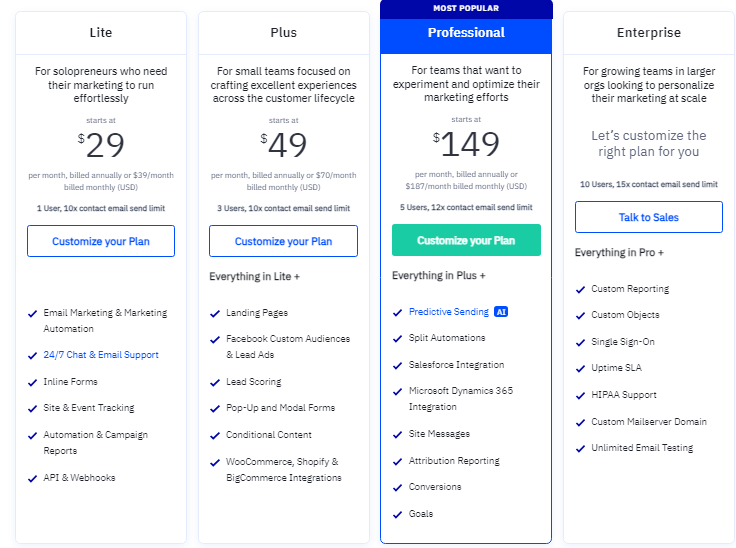
ActiveCampaign’s pricing model – as Figure 1.0 below – is based on features and the number of contacts. It offers four main plans: Lite, Plus, Professional, and Enterprise. The Lite plan starts with basic email marketing and costs are based on the number of contacts. As you move to higher tiers, additional features like CRM, automation, and split automations become available. The higher-tier plans are more comprehensive, but they also come with a higher price tag. While these plans offer a broader range of functionalities, the cost can increase significantly as the number of contacts grows, making it potentially expensive for businesses with larger contact lists.
It’s important to note that ActiveCampaign offers a free trial to explore its features before committing to a paid plan. This allows users to test the platform’s functionalities and assess its suitability for their specific business needs.
Constant Contact:
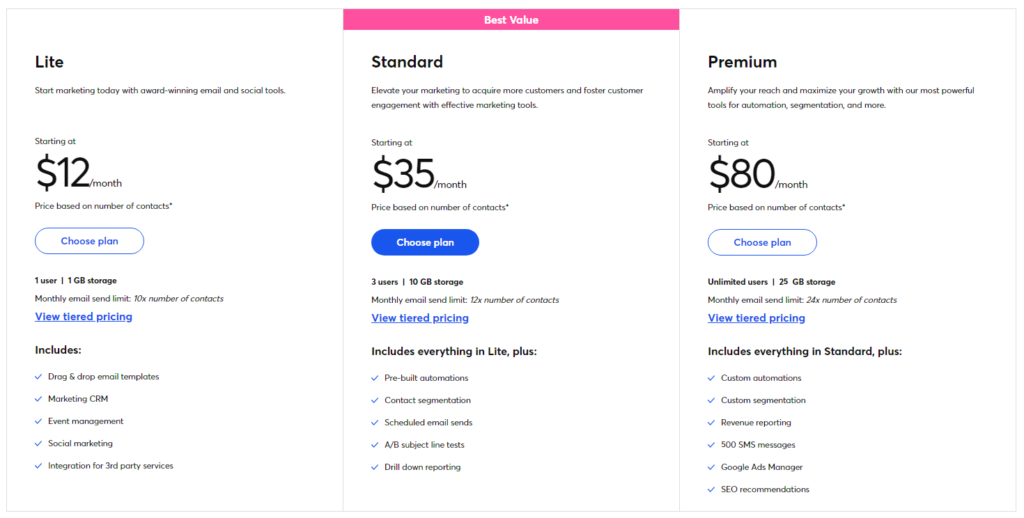
Constant Contact’s pricing structure is primarily based on the features available in different plans. It currently offers – as Figure 2.0 below – Lite, Standard, and Premium plans. The Lite plan caters to basic email marketing needs, offering features such as customizable templates, list segmentation, and analytics. The Standard plan includes added features like automated email campaigns and surveys.
Constant Contact’s pricing is also influenced by the number of contacts. As the number of contacts increases, the cost of the plan rises accordingly. The E-commerce plan, tailored for online stores, provides additional functionalities like online sales tracking and abandoned cart emails.
Similar to ActiveCampaign, Constant Contact offers a free trial period, enabling users to test the platform’s capabilities before committing to a paid plan.
Comparison:
ActiveCampaign’s pricing is based on both features and the number of contacts, making it potentially more expensive as the contact list grows or as more advanced functionalities are required. The comprehensive features, especially in higher-tier plans, cater to businesses seeking advanced automation and CRM capabilities.
Constant Contact’s pricing, also influenced by the number of contacts, offers more straightforward plans that might be more accessible for beginners or smaller businesses. Its tiered plans cater to varying needs, with an emphasis on ease of use and user-friendly templates.
Understanding the pricing structures and how they align with specific business needs is essential for making an informed decision when choosing an email marketing platform as an alternative to ActiveCampaign. When considering an alternative to ActiveCampaign Businesses need to consider their budget and the features that are essential for their marketing strategies to select the most cost-effective option. Please see my email marketing guide at: Mastering Email Marketing.
Pros & Cons
ActiveCampaign’s strengths lie in its advanced automation, robust CRM, and segmentation tools. However, its learning curve and potentially higher costs could be seen as drawbacks. The alternative to ActiveCampaign Constant Contact’s user-friendly interface and excellent customer support are advantageous, but its automation features might seem limited for some users.
Integrations
When comparing an alternative to ActiveCampaign both platforms offer integrations with numerous third-party apps and services. ActiveCampaign integrates well with various tools, including CRMs and e-commerce platforms. Constant Contact also has a wide range of integrations, especially focusing on e-commerce and social media.
Deliverability
Deliverability rates play a crucial role in email marketing success. ActiveCampaign’s deliverability rates are usually high, thanks to its focus on personalization and segmentation. When considering an alternative to ActiveCampaign Constant Contact also maintains good deliverability rates, emphasizing compliance and best practices.
Data Protection
Both platforms prioritize data protection which is good to know when considering an alternative to ActiveCampaign, complying with major data protection regulations. ActiveCampaign and Constant Contact ensure security measures are in place to safeguard user data, adhering to GDPR and other relevant laws.
A/B Testing
A/B testing, also known as split testing, is an essential feature for optimizing email marketing campaigns. It allows users to compare two versions of a campaign element to determine which performs better. Here’s how ActiveCampaign and the alternative to ActiveCampaign Constant Contact handle A/B testing:
ActiveCampaign:
ActiveCampaign provides robust A/B testing capabilities, allowing users to test various elements within their campaigns. Users can experiment with different subject lines, email content, images, or even sender names to determine what resonates best with their audience. The platform offers the ability to split test automated emails, enabling users to refine and enhance automated sequences for optimal performance.
The A/B testing feature in ActiveCampaign provides detailed analytics and insights, allowing users to measure the success of each variation. This information is invaluable for making data-driven decisions and refining future campaigns for improved engagement and conversions.
Constant Contact:
In Constant Contact, A/B testing options are available to help users compare email campaigns based on different subject lines, email content, or send times. However, the A/B testing functionality might not be as extensive or detailed as ActiveCampaign’s. Users can test two different subject lines or email contents to understand which version yields better results.
While Constant Contact’s A/B testing capabilities might be more limited in scope compared to ActiveCampaign, it still offers valuable insights into campaign performance, enabling users to make informed decisions about their email marketing strategies.
Comparison:
ActiveCampaign’s A/B testing capabilities provide a more comprehensive range of options, allowing users to test and optimize various elements within their campaigns, including automated sequences. The platform delivers detailed analytics, empowering users to make data-driven decisions for improved campaign performance.
As an alternative to ActiveCampaign Constant Contact’s A/B testing is more straightforward, allowing users to test subject lines, email content, and send times. While not as extensive as ActiveCampaign’s options, it still provides valuable insights into campaign performance.
Understanding the A/B testing capabilities of each platform is crucial for businesses seeking to fine-tune their email campaigns and optimize their strategies for better engagement and conversions. Users needing extensive testing options might find ActiveCampaign more suitable, while Constant Contact’s simpler A/B testing may suffice for those with less complex testing needs.
Alternative to ActiveCampaign
While either ActiveCampaign or Constant Contact are solid choices, they are not the only players in the email marketing arena. Some alternatives to consider include:
- MailerLite: Offers a robust set of automation features.
- Aweber: user friendly email campaign builder and automation.
- Brevo: Ideal for small businesses with a wide range of marketing needs.
Conclusion/Summary
In conclusion, the ‘best’ choice between ActiveCampaign and Constant Contact depends on your specific business needs. ActiveCampaign is more suitable for businesses requiring advanced automation and CRM functionalities, while Constant Contact is ideal for those prioritizing user-friendly interfaces and simplicity. When choosing an alternative to ActiveCampaign it is best review all options that relevant to your specific email marketing needs before making a decision.
Ready to supercharge your business, click on the buttons below to try either ActiveCampaign or Constant Contact!