

Introduction to Bitcoin Power Law and Its Volatility
Bitcoin, launched in 2009 by an anonymous entity known as Satoshi Nakamoto, represents the first decentralized digital currency to gain widespread adoption. As a form of currency that operates on a peer-to-peer network, it allows users to transact directly with one another without the need for intermediaries like banks. This decentralization and the underlying blockchain technology contribute to the unique attributes of Bitcoin, including transparency, security, and limited supply, all of which play a crucial role in its price dynamics.
Since its inception, Bitcoin has exhibited remarkable volatility, marked by rapid and unpredictable price movements. The cryptocurrency market, while presenting opportunities for substantial gains, is notoriously known for its fluctuations, which can be significantly influenced by various factors. Events that trigger price changes may include regulatory updates, technological advancements, market sentiment, media coverage, and macroeconomic trends. These fluctuations can often lead to substantial ramifications for investors, necessitating a keen understanding of the underlying mechanisms at play.
For investors and enthusiasts alike, comprehending the patterns of Bitcoin’s price shifts is essential for informed decision-making. The cryptocurrency’s value can experience dramatic increases, often followed by equally steep declines, which can be disconcerting for those unfamiliar with the market. As such, recognizing the inherent volatility of Bitcoin not only equips potential investors with the necessary knowledge to navigate the market but also aids in developing strategies to capitalize on price movements.
In summary, Bitcoin serves as a prime example of how digital currencies can disrupt traditional financial systems. Given its volatility, a thorough understanding of the factors influencing price fluctuations in the cryptocurrency market is paramount. This knowledge will aid stakeholders in making informed choices and embracing the potential of Bitcoin as a viable asset in their investment portfolios.
The Concept of Bitcoin Power Law in Financial Markets
The concept of power law is a statistical principle observed in various complex systems, including financial markets. It refers to a specific functional relationship between two quantities whereby one quantity varies as a power of another. In the context of financial markets, power laws often manifest in the distribution of asset prices, trading volumes, and market returns. Unlike traditional assumptions of normal distribution, power laws indicate that extreme events—such as significant price swings in assets like bitcoin—occur more frequently than would be predicted by normal distribution. This non-linear interaction points towards the innate complexity of financial behaviors.
Mathematically, power laws can be represented as a straightforward expression, where the frequency of an event is inversely proportional to its size, often depicted as ( P(x) propto x^{-alpha} ), where ( P(x) ) is the probability of an event that is equal to or greater than ( x ), and ( alpha ) is a constant that determines the degree of the power law. In financial markets, this has notable implications for predicting market trends. For instance, if we consider the valuation of cryptocurrencies such as bitcoin, instances of skyrocketing prices alongside significant drops can be explained by the principles of power law. Markets tend to cluster around certain price levels, with high volatility contributing to the power law’s ability to predict behavior over time.
The relevance of power laws extends beyond merely understanding price fluctuations; they are critical in grasping the dynamics that govern market behavior during both bullish and bearish trends. Financial phenomena such as market crashes or bubbles often exhibit power law characteristics, highlighting their potential to forecast not just trends, but also the likelihood of extreme events occurring. In summary, power law principles serve as a vital tool for investors and analysts seeking to navigate the complexities of an ever-evolving financial landscape.
Defining the Bitcoin Power Law Formula
The Bitcoin Power Law formula is instrumental in estimating the price of Bitcoin based on a simple mathematical model. Formulated as estimated price = a (days from gb)^n, this equation involves several parameters that carry significant implications for predicting Bitcoin’s future value. In this formula, ‘gb’ represents the genesis block, which serves as the foundational block in the Bitcoin blockchain. This is a crucial reference point since it marks the start of Bitcoin’s existence and, hence, the beginning of its price trajectory.
The parameter ‘a’ in the equation represents a constant that is determined based on historical pricing data, serving as a scaling factor. By leveraging data collected since the genesis block, analysts can deduce a suitable value for ‘a’ that aligns the formula with actual Bitcoin prices observed over time. The exponent ‘n’ is fixed at 5.8, a value chosen based on empirical analysis of Bitcoin’s price behavior, reflecting the distinct market dynamics and growth patterns associated with cryptocurrencies.
This bitcoin power law emphasizes the nonlinear nature of Bitcoin’s price movement, suggesting significant fluctuations connected to the passage of time since the genesis block. As ‘days from gb’ increases, the estimated price of Bitcoin escalates according to the power of the exponent, signifying the potential for rapid price increases as the market matures. Changing the values of ‘a’ or ‘n’ can produce different projections, thereby affecting the assessments made about the cryptocurrency’s future. Understanding this formula enables investors and analysts to make more informed decisions about Bitcoin investments, helping them navigate the volatile landscape of cryptocurrency with a rigorously calculated approach.
Analyzing Historical Data Through the Bitcoin Power Law Model
Understanding the price movements of bitcoin requires a comprehensive examination of historical data, which can be effectively analyzed using the power law model. The bitcoin power law model provides a mathematical representation of the relationship between various data points, allowing analysts to discern patterns and make future predictions based on past trends. In the context of bitcoin, this model highlights how price fluctuations may follow a predictable pattern relative to specific variables, such as the number of days since the genesis block was created.
To begin with, selecting relevant historical data points is crucial. Analysts often focus on specific timeframes, such as daily closing prices since the inception of bitcoin. This offers a robust dataset for applying the bitcoin power law model. Each data point contributes to understanding how the price of bitcoin has evolved over time and how it may react to market forces. By collating prices against time, the relationships can yield insights into potential price forecasts based on past behavior.
The calculation methods used within the power law framework involve statistical analysis techniques that seek to identify correlations and disparities among the selected data points. By applying regression analysis, analysts can establish a power law exponent, which serves as an indicator of how predictably bitcoin’s price behaves. Higher exponents often signal increased volatility, while lower exponents may suggest relative stability.
Historical examples provide essential context for the power law model in action. For instance, during significant market events such as the 2017 bull run, the power law model demonstrated a pronounced correlation between price increases and active trading volumes. Such case studies reinforce the importance of the power law model in facilitating a deeper understanding of how bitcoin prices may change over time, ultimately offering valuable predictive insights for investors and analysts alike.
Future Price Predictions Using Bitcoin Power Law
The bitcoin power law model has gained recognition as a valuable tool for forecasting price fluctuations in markets characterized by extremes and volatility, such as cryptocurrency. Through the analysis of historical data and price distributions, this model is particularly useful for predicting Bitcoin’s future price trajectory. By examining past price behaviors and their statistical significance, the bitcoin power law allows for projections that can guide investment decisions in both short-term and long-term contexts.
Historically, Bitcoin has demonstrated patterns that conform to the characteristics of a power law distribution. This suggests that significant price movements are often followed by less frequent but substantial shifts. By utilizing this model, analysts can discern possible price ranges and trends based on previous spikes and declines. For instance, should Bitcoin maintain its previous growth rates while experiencing increasing adoption, the power law could signal an upward price trajectory over the next few years.
In the short term, market volatility can introduce unpredictable elements that may not align with power law forecasts. However, the model still holds validity for producing estimates around potential price points influenced by market news, regulatory changes, and technological advancements. Investors can harness this knowledge to establish expectations and devise strategies, such as setting targets for buying or selling based on predicted price floors and ceilings.
In the long term, if the broader acceptance of Bitcoin continues, bitcoin power law predictions suggest a gradual rise in value, especially as supply constraints become more pronounced due to the capped maximum supply of 21 million coins. Analyzing various scenarios through this lens helps investors to navigate the complexities of market dynamics and make judicious choices. Therefore, while future fluctuations are inherently uncertain, leveraging power law predictions enhances strategic investment approaches within the realm of cryptocurrency. Figure 1.0 below illustrates the Bitcoin Power Law Growth Model, which highlights Bitcoin’s price movement over time within a logarithmic scale. This model uses a linear regression fit (green line) to capture Bitcoin’s long-term growth trend, bounded by support (red line) and resistance (purple line) levels. These boundaries form a “power-law corridor,” showing how Bitcoin’s price oscillates predictably within these limits over the years. The model suggests that despite short-term volatility, Bitcoin’s price adheres to a long-term exponential growth trajectory, as depicted by its adherence to the corridor since 2011.
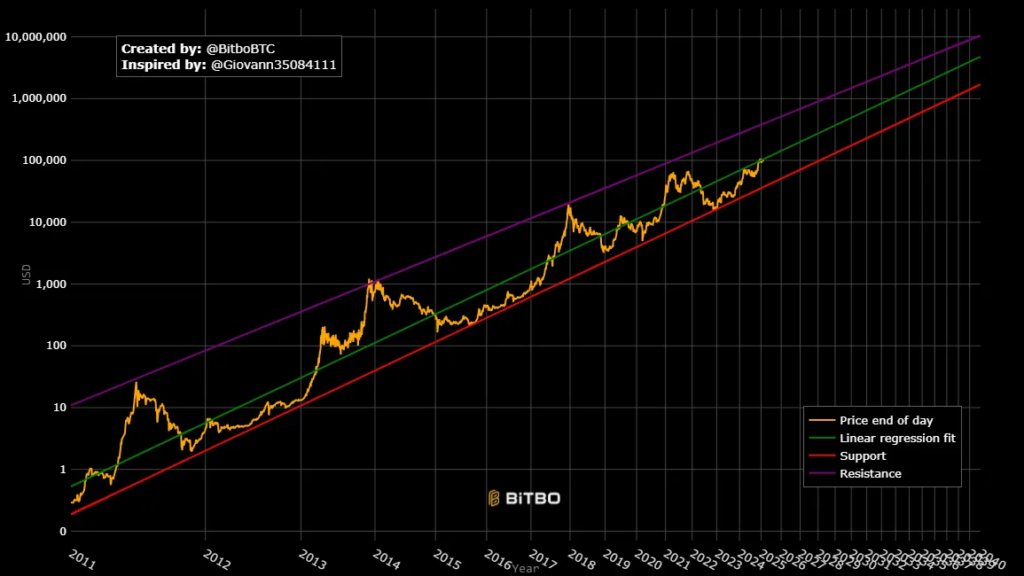
Figure 1.0 – BiTBO Long Term Power Law Chart as of 8th Feb., 2025
Limitations of the Bitcoin Power Law Model in Predicting Bitcoin Prices
The bitcoin power law model, while providing valuable insights into trends and price movements, presents significant limitations in the context of predicting Bitcoin prices. One of the foremost challenges is the inherent volatility that characterizes the cryptocurrency market. Prices of Bitcoin often experience rapid fluctuations, driven by a multitude of factors that can disrupt established patterns. Such unpredictability makes it difficult for power law models, which are predicated on past price behavior and statistical observations, to reliably forecast future values. This limitation is especially pronounced during periods of heightened market activity when prices can swing dramatically in a matter of hours.
Furthermore, the influence of external factors poses another considerable challenge. Regulatory changes are particularly impactful; announcements regarding legislation can trigger sharp reactions in the market, leading to price spikes or plunges that the power law model is unlikely to anticipate. Additionally, factors such as market sentiment, news events, and technological advancements can sway Bitcoin prices. For instance, widespread negative sentiment following security breaches or fraudulent activities may drive prices down rapidly, while positive news regarding adoption or technological improvements can lead to surges. These external elements often introduce a level of unpredictability that a bitcoin power law model cannot effectively address.
Lastly, one must consider the unique nature of the cryptocurrency market itself, which is still maturing and evolving. Bitcoin, despite being one of the oldest and most established cryptocurrencies, operates in a relatively nascent ecosystem, laden with uncertainties. As traders and investors navigate this complex landscape, the potential for inaccuracies in price predictions based on a power law framework should be acknowledged. Thus, while the power law model can inform and guide discussions regarding Bitcoin price trajectories, it should be utilized with caution, recognizing its notable limitations amidst the dynamic environment of cryptocurrency trading.
Comparing Bitcoin Power Law with Other Price Prediction Models
When examining methods used for predicting the price of Bitcoin, it is essential to draw comparisons between the power law model and other prevalent approaches, including technical analysis, fundamental analysis, and various mathematical models. The bitcoin power law model, which emphasizes the disproportionate relationship between the price and its influential factors, possesses unique strengths that distinguish it from its counterparts.
Technical analysis primarily focuses on historical price data and attempts to identify patterns through charts and indicators. While this method can provide insights into short-term price movements, it often falls short in correlating with Bitcoin’s underlying value shifts over the long term. The reliance on historical trends can lead to false signals and may not effectively account for external factors influencing the market, such as regulatory changes or innovations in blockchain technology.
On the other hand, fundamental analysis evaluates the intrinsic value of Bitcoin by considering external factors like market demand, adoption rates, and macroeconomic conditions. While this method offers a comprehensive view of the cryptocurrency’s potential, it can be limited by the unpredictable nature of technological advancements and market sentiment. Bitcoin’s volatile price behavior often defies fundamental assessment, making it challenging to apply traditional economic principles.
Moreover, several mathematical models, such as the Black-Scholes option pricing model, have been adapted for Bitcoin to forecast price movements. However, these models typically rely on stable market conditions, creating limitations in capturing the high volatility seen in Bitcoin trading. Unlike these conventional approaches, the power law model suggests that price changes exhibit scalability, providing a robust framework for understanding significant price shifts. This aspect allows investors and analysts to better gauge potential future fluctuations in Bitcoin’s price based on observable historical patterns.
Ultimately, while various models contribute to the overall understanding of Bitcoin’s price dynamics, the distinctive features of the power law model provide a valuable perspective in navigating the complex and often unpredictable landscape of cryptocurrency investment.
The Role of Investor Sentiment in Price Fluctuations
Investor sentiment is a pivotal factor in the realm of Bitcoin and its price fluctuations. As a decentralized digital currency, Bitcoin is subject to the psychological influences of its investors, which can often lead to heightened volatility. This volatility is not merely a function of market fundamentals; rather, it is significantly influenced by the collective emotions and attitudes of traders and investors. When there is widespread optimism about Bitcoin’s future, for instance, prices tend to surge as more individuals are inclined to buy in. Conversely, when negativity permeates the market, prices can plummet due to panic selling.
The intertwining of investor sentiment with mathematical models, particularly the power law, provides valuable insights into Bitcoin’s price behavior. The power law suggests that price fluctuations follow a predictable pattern, heavily influenced by the buying and selling pressures exerted by emotional traders. For example, during positive market trends, optimism can create a self-reinforcing cycle where increasing prices attract more investors, driving prices even higher. On the other hand, during downturns, fear can trigger a rapid decline as investors rush to sell, further exacerbating price drops.
Real-world events and news cycles frequently impact investor sentiment, causing sharp price changes. Major announcements, regulatory developments, and technological advancements in the Bitcoin ecosystem can sway public perception, thus creating fluctuations in price. Moreover, social media platforms play a notable role in amplifying sentiments; discussions on platforms like Twitter or Reddit can lead to herd behavior, where traders buy or sell based on popular sentiment rather than fundamentals. The interconnectedness of social perception and investor behavior illustrates the complex dynamics at play in the Bitcoin market, further emphasizing the critical role of sentiment in predicting price movements.
Conclusion: Embracing Uncertainty in Bitcoin Investments
In reflecting on the Bitcoin power law and its implications for forecasting price fluctuations, it is evident that while this model provides valuable insights, it is not infallible. The power law phenomenon highlights the dynamic nature of the cryptocurrency market, suggesting that Bitcoin’s price behavior can follow theoretical patterns but remains influenced by a multitude of unpredictable factors. From regulatory changes to technological advancements, the Bitcoin ecosystem is ever-evolving, making precise predictions challenging.
Investors should also take into account the inherent volatility associated with Bitcoin and cryptocurrencies at large. Unlike traditional investments, Bitcoin markets can experience rapid and significant price changes within a short period, strongly influenced by market sentiment, global events, and investor behavior. Therefore, while the power law can serve as a useful tool for understanding potential price movements, it is crucial for investors to recognize that reliance solely on this model could lead to misguided decisions.
Moreover, successful Bitcoin investments require a holistic approach. It is essential to consider fundamental factors such as market trends, the underlying technology behind Bitcoin, and macroeconomic indicators that can influence investor confidence. Diversification of investment strategies, coupled with thorough research and an awareness of market psychology, can serve as protective measures against the uncertainty that permeates the cryptocurrency landscape.
In conclusion, navigating the complex world of Bitcoin investments necessitates a blend of analytical tools, such as the power law model, and an understanding of the unpredictable nature of the digital currency market. By embracing this uncertainty, investors can better position themselves to adapt to fluctuations and seize opportunities in the evolving cryptocurrency space.
This blog post first appeared on CompareEcoms.Com.