

Intro:
Email marketing is one of the most effective ways to reach your target audience, build trust, and increase conversions. But how do you choose the right email marketing platform for your business? In this blog post, we will review Constant Contact, one of the leading email marketing platforms on the market. We will cover its features, pros and cons, pricing, integrations, deliverability, data protection, alternatives, and more. By the end of this post, you will have a clear idea of whether Constant Contact is the right choice for your email marketing needs.
Table of Contents
What is Constant Contact?
Constant Contact is an online marketing platform that helps small businesses and nonprofits create and send professional-looking emails, newsletters, and campaigns. It also offers other marketing solutions such as website builder, ecommerce, social media, and lead generation tools. Constant Contact was founded in 1995 and has over 600,000 customers worldwide.
Features
Constant Contact has a lot of features to help you create and manage your email marketing campaigns. Some of the main features are:
- Drag-and-drop email editor: You can easily design beautiful and responsive emails using the drag-and-drop editor. You can choose from hundreds of templates, customize them with your own images, colors, fonts, and content, or create your own from scratch.
- Contact management: You can import, organize, and segment your contacts using various criteria such as name, email, location, interests, behavior, and more. You can also sync your contacts with other apps such as Shopify, WordPress, Salesforce, and more.
- Automation: You can set up automated emails based on triggers such as welcome, birthday, anniversary, abandoned cart, and more. You can also create workflows to send a series of emails based on your subscribers’ actions or inactions.
- Analytics: You can track and measure the performance of your email campaigns using the built-in analytics dashboard. You can see metrics such as open rate, click rate, bounce rate, unsubscribe rate, and more. You can also compare different campaigns and test different versions of your emails to see what works best.
- Support: You can get help from the Constant Contact team via phone, chat, or email. You can also access the online knowledge base, community forum, blog, and webinars for more tips and guidance.
Pros & Cons
Constant Contact has many advantages, but also some drawbacks. Here are some of the pros and cons of using Constant Contact for your email marketing.
Pros:
- Easy to use: has a user-friendly interface that makes it easy to create and send emails. You don’t need any coding or design skills to use it.
- Feature-rich: has a lot of features to help you with your email marketing and other online marketing needs. You can create and send emails, newsletters, surveys, coupons, events, and more. You can also integrate it with other apps and tools to enhance your marketing efforts.
- Deliverability: has a high deliverability rate, which means that your emails are more likely to reach your subscribers’ inboxes and avoid spam filters. Constant Contact also complies with the CAN-SPAM Act and other email marketing regulations.
- Support: has a dedicated and helpful support team that you can reach via phone, chat, or email. You can also access the online resources and learning materials to get more help and advice.
Cons:
- Pricing: is not the cheapest email marketing platform on the market. Its plans start from $12 per month for up to 500 contacts, and go up to $195 per month for up to 50,000 contacts. If you have a large contact list, you may find Constant Contact too expensive for your budget.
- Customization: does not offer a lot of customization options for your emails. You can only choose from the predefined templates, colors, fonts, and layouts. You cannot edit the HTML or CSS code of your emails, which may limit your creativity and branding.
- Templates: has a large library of email templates, but some of them look outdated and generic. You may not find a template that matches your niche or industry. You may also have to spend some time tweaking the templates to make them look more appealing and professional.
Pricing
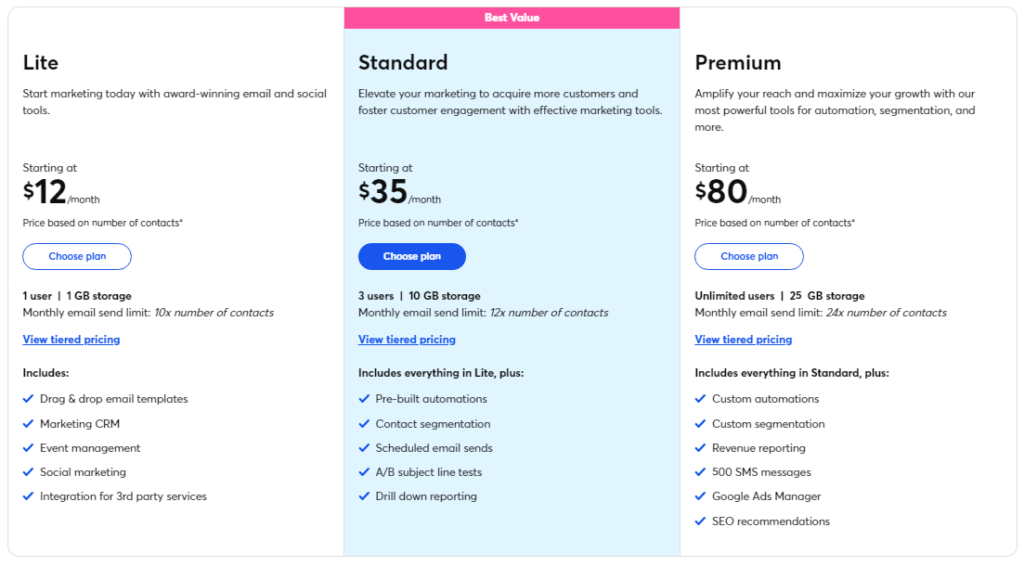
Here is a brief overview of the three pricing plans and also detailed in Figure 1.0 below:
- Lite: This plan is suitable for beginners who want to start marketing today with award-winning email and social tools. It costs $12 per month for up to 10x contacts, and includes features such as drag-and-drop email templates, contact management, event management, social marketing, and integration for 3rd party services. The monthly email send limit is 10x the number of contacts.
- Standard: This plan is ideal for businesses who want to elevate their marketing to acquire more customers and foster customer engagement with effective marketing tools. It costs $35 per month for up to 12x contacts, and includes everything in Lite, plus features such as pre-built automations, contact segmentation, scheduled email sends, A/B subject line tests, drill down reporting, and more. The monthly email send limit is 12x the number of contacts.
- Premium: This plan is designed for businesses who want to amplify their reach and maximize their growth with the most powerful tools for automation, segmentation, and more. It costs $80 per month for up to 24x contacts, and includes everything in Standard, plus features such as custom automations, custom segmentation, revenue reporting, 500 SMS messages, Google Ads Manager, SEO recommendations, and more. The monthly email send limit is 24x the number of contacts.
Please review current pricing by selecting the image link in Figure 1.0 below.
You can also get a 15% discount if you pay annually, and a 30% discount if you are a nonprofit organization. You can also try Constant Contact for free for 60 days, with no credit card required.
Integrations
Constant Contact has a lot of integrations with other apps and tools that you can use to enhance your email marketing and online marketing efforts. Some of the most popular integrations are:
- Shopify: You can sync your Shopify store with Constant Contact and send targeted emails to your customers based on their purchase history, behavior, and preferences. You can also track the revenue generated from your email campaigns and optimize your marketing strategy.
- WordPress: You can connect your WordPress site with Constant Contact and add sign-up forms, pop-ups, and landing pages to grow your email list. You can also create and send emails directly from your WordPress dashboard and track the performance of your campaigns.
- Salesforce: You can integrate your Salesforce CRM with Constant Contact and sync your contacts, leads, and opportunities. You can also segment your contacts based on their sales stage, activity, and profile, and send personalized emails to nurture them and close more deals.
- Zapier: You can use Zapier to connect Constant Contact with over 3,000 other apps and tools that you use for your business. You can create workflows and automate tasks such as adding new contacts, sending emails, updating records, and more.
Deliverability
Email deliverability is the lifeline of any successful email marketing campaign. It refers to the ability of your emails to reach the intended recipients’ inboxes without being flagged as spam. Constant Contact places a strong emphasis on deliverability, understanding its pivotal role in the effectiveness of your marketing efforts.
Constant Contact’s Deliverability Rates
Constant Contact boasts high deliverability rates, thanks to its commitment to maintaining positive sender reputation and adhering to industry best practices. The platform employs sophisticated algorithms and practices to ensure your emails have the best chance of landing in the inbox rather than being consigned to the spam folder.
Factors Influencing Deliverability
Permission-Based Marketing: Constant Contact encourages permission-based marketing, ensuring that your emails are sent to individuals who have willingly opted in to receive them. This approach not only enhances deliverability but also contributes to a more engaged and receptive audience.
List Hygiene: Regularly cleaning and maintaining your email list is a crucial aspect of deliverability. Constant Contact provides tools to help you manage your subscriber list effectively, reducing the likelihood of sending emails to inactive or incorrect addresses.
Authentication Protocols: The platform supports industry-standard authentication protocols like SPF (Sender Policy Framework) and DKIM (DomainKeys Identified Mail). These protocols verify the authenticity of your emails, preventing them from being flagged as suspicious or fraudulent.
Content Quality: Constant Contact provides guidelines to help you create high-quality, relevant, and non-spammy content. By adhering to these guidelines, you enhance the chances of your emails passing through spam filters and reaching the inbox.
Monitoring and Reporting
Constant Contact equips users with tools to monitor the deliverability of their campaigns. The platform provides insights into metrics such as bounce rates, open rates, and spam reports. By regularly analyzing these metrics, you can identify and address issues that might be affecting your deliverability.
Support and Guidance
Should you encounter deliverability challenges, Constant Contact offers customer support and resources to guide you through the resolution process. The platform’s commitment to customer success extends to ensuring that your emails consistently reach your audience.
Constant Contact vs. Industry Standards
Comparing Constant Contact’s deliverability rates with industry standards is essential. Constant Contact often performs favorably in these comparisons, assuring users that their emails are in good hands and are likely to achieve optimal deliverability rates.
In conclusion, Constant Contact’s focus on deliverability is a testament to its dedication to helping businesses succeed in their email marketing endeavors. By choosing Constant Contact, you’re not only gaining access to powerful marketing tools but also ensuring that your messages reach the right audience consistently.
Data Protection
Data protection is the practice of safeguarding your subscribers’ personal information and respecting their privacy rights. Data protection is not only important for your subscribers’ trust and loyalty, but also for complying with the laws and regulations that govern email marketing, such as the GDPR, the CCPA, and more. Constant Contact is committed to data protection and security, and offers various features and tools to help you protect your subscribers’ data, such as:
- SSL encryption: Constant Contact uses SSL encryption to secure the data that is transmitted between your browser and its servers. SSL encryption prevents hackers and third parties from intercepting or tampering with your data.
- Permission-based marketing: Constant Contact follows the permission-based marketing principle, which means that you can only send emails to people who have explicitly given you their consent to do so. Constant Contact also provides you with opt-in forms, double opt-in confirmation, and unsubscribe links to help you obtain and maintain your subscribers’ permission.
- Data processing agreement: Constant Contact offers a data processing agreement (DPA) to its customers who are subject to the GDPR or other data protection laws. A DPA is a legal document that outlines the roles and responsibilities of both parties regarding the processing of personal data. A DPA helps you comply with the data protection laws and demonstrate your accountability.
- Privacy policy: Constant Contact has a clear and transparent privacy policy that explains how it collects, uses, and shares your and your subscribers’ personal data. You can access the privacy policy on its website and review it at any time.
Constant Contact is not the only email marketing platform on the market. There are many other alternatives that you can consider, depending on your needs, preferences, and budget. Some of the most popular alternatives are:
- Benchmark Email: Benchmark Email is an email marketing platform that offers a free plan for up to 2,000 contacts and 14,000 emails per month. Benchmark Email has a drag-and-drop email editor, a large library of templates, and a responsive design. However, Benchmark Email has limited automation and segmentation options, and its email deliverability is not as high as Constant Contact’s.
- ActiveCampaign: ActiveCampaign is an email marketing platform that focuses on automation and personalization. ActiveCampaign has a powerful automation builder, a CRM system, and a machine learning feature that optimizes your email campaigns. However, ActiveCampaign is more expensive than Constant Contact, and its interface is not as user-friendly and intuitive as Constant Contact’s.
- MailerLite: MailerLite is an email marketing platform that offers a free plan for up to 1,000 contacts and 12,000 emails per month. MailerLite has a simple and elegant interface, a flexible email editor, and a landing page builder. However, MailerLite has fewer features and integrations than Constant Contact, and its customer support is not as responsive and helpful as Constant Contact’s.
- Brevo: Brevo is an email marketing platform that uses artificial intelligence to create and optimize your email campaigns. Brevo has a smart email generator, a content optimization tool, and a campaign analytics dashboard. However, Brevo is still in beta mode, and its features and functionality are not as mature and reliable as Constant Contact’s.
- AWeber: AWeber is an email marketing platform that has been around for over 20 years. AWeber has a free plan for up to 500 contacts and 3,000 emails per month, which is similar to Constant Contact’s. AWeber also has a rich set of features, such as a smart email designer, a landing page builder, and a campaign marketplace. However, AWeber’s interface is not as modern and intuitive as Constant Contact’s, and its pricing plans are not as flexible as Sendinblue’s. AWeber also has lower email deliverability than Constant Contact.
Other relevant topics
While exploring Constant Contact’s features, pricing, and performance is crucial, delving into additional insights can further enhance your marketing strategy. Here are some additional topics that can amplify your understanding and utilization of Constant Contact:
- Email Marketing Best Practices: Maximizing Engagement
Uncover the tried-and-true best practices for crafting compelling emails that captivate your audience. From attention-grabbing subject lines to persuasive content, learn how to make your emails stand out in crowded inboxes. - Automation Strategies for Time-Efficient Campaigns:
Dive into advanced automation strategies to streamline your marketing campaigns. Discover how to set up drip campaigns, automate follow-ups, and leverage behavioral triggers to create personalized, timely interactions with your audience. - Segmentation Tactics: Targeting the Right Audience
Explore the power of list segmentation and how it can revolutionize your email targeting. Learn how to segment your audience based on demographics, behavior, and preferences, ensuring your messages resonate with the right recipients. - Analytics Mastery: Leveraging Data for Success
Unearth the insights hidden in your campaign analytics. From open rates to click-through rates, understand how to interpret key metrics and optimize your future campaigns based on data-driven decisions. - Mobile Optimization: Reaching Audiences on the Go
In an era where mobile devices dominate, discover the importance of optimizing your emails for mobile users. Learn the best practices for responsive design and ensure your messages make a lasting impression, whether viewed on a desktop or smartphone. - A/B Testing for Continuous Improvement
Elevate your marketing game through A/B testing. Understand how to experiment with different elements of your emails, from subject lines to visuals, and use data to refine your approach continuously. - Personalization Strategies: Building Stronger Connections
Explore the art of personalization and how it can foster stronger connections with your audience. From dynamic content to personalized recommendations, discover ways to make every interaction feel tailored to the individual. - Compliance Corner: Navigating Email Regulations
Stay on top of the ever-evolving landscape of email regulations. Understand the compliance requirements, such as GDPR and CAN-SPAM, and ensure your email marketing practices align with industry standards and legal guidelines.
By delving into these additional topics, you’ll not only maximize your use of Constant Contact but also refine your overall email marketing strategy for sustained success. Constant Contact serves as a catalyst, and with these insights, your business is poised for unprecedented growth and engagement.
Conclusion/Summary
Constant Contact is a reliable and user-friendly email marketing platform that offers a variety of features and integrations. It is ideal for beginners who want to create and send professional-looking emails without much hassle. However, it may not be the best option for advanced users who need more customization and flexibility.
If you are interested in trying out Constant Contact, please click on the button to get started.